WHY MAKE IT
A little comfort, a lot of flavor.
Classic dark chocolate mousse remains an enduring foundation of French patisserie because it relies on mechanical aeration rather than gelatin or synthetic stabilizers. By trapping millions of microscopic air pockets within whipped egg whites and chilled heavy cream, the culinary matrix suspends cocoa butter in a delicate, cloud-like foam. Choosing chocolate between 64 and 70 percent cocoa solids provides the necessary balance: sufficient cocoa butter to solidify the mousse as it cools, paired with robust acidity and bitterness to counteract the sugar. Because raw egg preparations require careful attention to food handling, use pristine, fresh eggs, maintain clean utensils, and ensure thorough chilling to let the flavors develop fully before presenting to guests.
Selecting the Right Cocoa Percentage
The success of a mousse hinges on cocoa butter composition. High-percentage dark chocolate (above 72 percent) contains high amounts of cocoa solids and fats, which can stiffen prematurely when combined with cooler components, producing a grainy mouthfeel. Conversely, milk chocolate or low-percentage dark chocolate carries excess sugar and insufficient fat, resulting in a runny dessert that fails to hold its shape. A pure bittersweet chocolate rated between 64 and 70 percent hits the sweet spot, providing structural firmness while carrying enough complex bitterness to create a clean, non-cloying finish on the palate.
The Physics of Aeration and Folding
The light, spoonable density of mousse depends on two separate foam structures: a protein foam created by whipped albumin in egg whites, and an emulsion foam formed by agitated dairy milkfat. Folding requires a deliberate touch. The initial sacrifice of one-third of the egg whites lowers the overall viscosity of the dense chocolate base. Once loosened, the base accommodates the remaining whites and whipped dairy cream through gentle, wide arcs. Overworking ruptures the fragile cell walls of air bubbles, leading directly to a dense, rubbery pudding rather than an airy mousse.
Managing Chocolate Emulsion Temperatures
Temperature management is critical when combining melted chocolate with egg products. Chocolate melts cleanly between 40 C and 45 C (104 F to 113 F). If mixed with raw yolks while steaming hot, the proteins in the yolks will curdle into gritty scrambled bits. However, if the chocolate drops below 35 C (95 F), the cocoa butter begins recrystallizing. Adding cold dairy to cold chocolate forces the fats to seize into unpleasant waxy fragments. Keep the base lukewarm to the touch, and temper the components gradually for uniform emulsion.
Before you start
Cleanliness is essential when aerating egg whites; ensure your whisk and bowl are thoroughly washed with hot soapy water and dried completely, as even a tiny speck of yolk or oil can hinder volume expansion. Pay close attention to chocolate temperature when folding: if the melted chocolate is too cold, it will seize into hard flecks upon contact with cool ingredients; if too hot, it will deflate your whipped components.
THE RECIPE
Dark Chocolate Mousse
6 servings · 25 minutes preparation · 5 minutes cooking · 240 minutes cooling, chilling or resting
Ingredients
Step-by-step instructions
- Set a heatproof glass bowl over a saucepan with 2 cm of gently simmering water over low heat, ensuring the bowl bottom does not touch the water. Add the chopped chocolate, cubed butter, and warm espresso, stirring occasionally with a silicone spatula until smoothly melted, glossy, and registering roughly 45 C (113 F).
- Remove the chocolate bowl from the steam and let it sit on the counter for 5 to 7 minutes until barely warm to the touch, roughly 38 C (100 F). Whisk the 4 egg yolks vigorously in a separate small bowl with half of the granulated sugar, then gently incorporate them into the melted chocolate base.
- In a chilled metal bowl, whip the heavy cream and vanilla extract using a hand mixer on medium speed until soft, billowy peaks form, roughly 2 to 3 minutes. Take care not to overwhip the cream into stiff clumps; immediately transfer it to the refrigerator while preparing the egg whites.
- In a spotlessly clean, grease-free mixing bowl, whip the egg whites with the sea salt on medium-low speed until foamy. Gradually rain in the remaining sugar while increasing mixer speed to medium-high, continuing to whip until firm, glossy peaks form that hold their shape when the beaters are lifted, approximately 3 minutes.
- Lighten the chocolate-yolk mixture by vigorously stirring in one-third of the whipped egg whites with a flexible spatula until completely homogeneous. Gently fold in the remaining whites in two additions using slow, sweeping under-and-over motions, cutting through the center to preserve the delicate aerated structure without leaving visible white streaks.
- Fold the chilled whipped cream into the aerated chocolate base using the same gentle sweeping motion until evenly distributed and uniform in color. Divide the mousse evenly among 6 small glasses or ramekins, smoothing the tops lightly with a spoon, and wipe any drips clean from the glass rims.
- Cover each individual serving dish tightly with plastic wrap without touching the surface of the mousse. Transfer the ramekins to the refrigerator and chill for at least 4 hours, or preferably overnight, until thoroughly set, chilled throughout, and firm yet tender to a spoon, before finishing with shaved dark chocolate.
Kitchen notes
Cleanliness is essential when aerating egg whites; ensure your whisk and bowl are thoroughly washed with hot soapy water and dried completely, as even a tiny speck of yolk or oil can hinder volume expansion. Pay close attention to chocolate temperature when folding: if the melted chocolate is too cold, it will seize into hard flecks upon contact with cool ingredients; if too hot, it will deflate your whipped components.
Storage & make-ahead
Store individual portions tightly covered with plastic wrap in the refrigerator for up to 3 days. Do not freeze, as the ice crystal formation disrupts the fat emulsion and causes water separation upon thawing. Serve directly from the refrigerator to maintain stability.
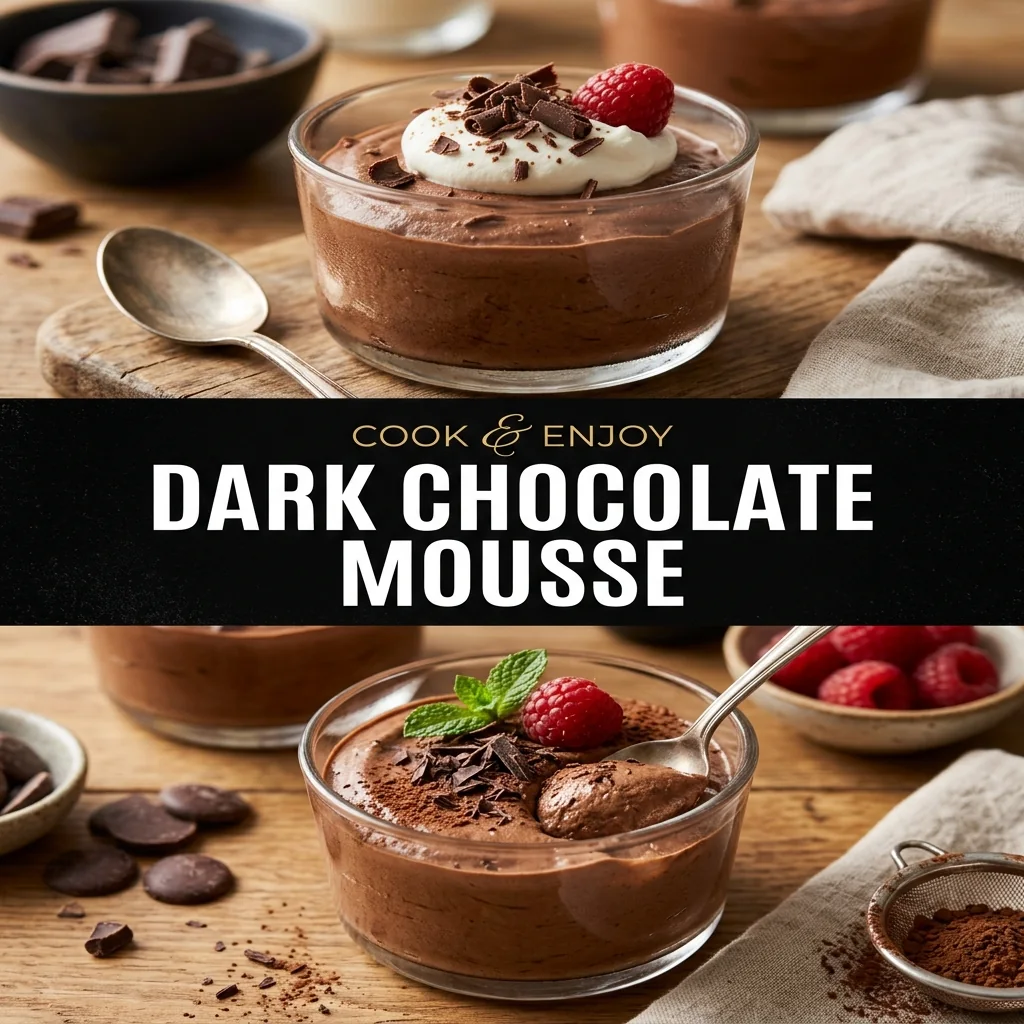
An original recipe guide inspired by themes in our Pinterest research. Recipe has not been independently kitchen-tested. AI-generated image is illustrative; your finished dish may look different.
Frequently asked questions
Can I omit the espresso from the chocolate base?
Yes, you can substitute the espresso with warm water. The small quantity of coffee does not impart a distinct coffee flavor; rather, the roasted bitterness simply heightens and deepens the natural aroma and fruitiness of the cocoa beans.
Why did my chocolate seize into a stiff paste during melting?
Chocolate seizes when a tiny droplet of stray water enters dry melted chocolate, causing sugar crystals to bind into clumps. To prevent this, ensure bowls are completely dry, or add sufficient liquid (like warm espresso) upfront so sugars dissolve smoothly.
Is it safe to consume mousse containing uncooked eggs?
Traditional mousse recipes rely on raw whipped eggs. If serving pregnant individuals, young children, or immunocompromised individuals, purchase pasteurized in-shell eggs from the grocery store, which have undergone heat treatment to eliminate bacterial risks without cooking the protein.